No heat at 11 p.m. They call you once.
HVAC emergencies do not wait for office hours, and a homeowner with a dead furnace calls the next contractor on Google within a minute. Voice Intego answers every call in half a second, triages the emergency, quotes your call-out fee, and books the job, day or night.
An AI receptionist for HVAC companies that pays for itself on one saved call.
Your phone is your pipeline. This is what happens to it on a normal week.
Your phone problem is seasonal, and it peaks exactly when it costs most.
The first heat wave breaks your phone line
Demand does not arrive evenly. The first freeze and the first 95-degree day generate a week of calls in an afternoon, and that is precisely when every tech is booked and nobody can pick up. An HVAC AI agent answers several calls at the same time, so the fifth caller in a row is not pushed to voicemail while one person works through the queue.
Your crew cannot answer and work
A tech in a crawlspace with a multimeter is not taking a call, and if they do, they are losing billable time. Voice AI for HVAC takes the call so the job in front of them stays the priority.
Emergencies and quotes need different handling
A no-heat call and a maintenance plan question are not the same call. An AI dispatcher for HVAC triages by urgency, so the emergency reaches your on-call tech and the quote request lands in the morning queue.
How your AI receptionist handles every HVAC call.
An AI agent for HVAC that works your schedule, your service area and your pricing. An HVAC virtual receptionist, tuned to your business rather than a generic script.
Qualify the job before anyone is dispatched
System type, age, symptoms, whether there is heat or cooling at all, and whether the address is in your service area. Your tech arrives knowing what they are walking into instead of guessing from a callback slip.
Triage urgency against your rules
You define what counts as an emergency. No heat with a newborn in the house is not the same as a noisy condenser. The agent applies your criteria and escalates only what genuinely needs waking someone up.
Book, quote the call-out, and confirm
The agent books into your calendar, states your diagnostic or call-out fee so there is no argument at the door, and texts the customer a confirmation with the arrival window.
Four real calls. Four different plays.
Same agent, four very different calls, all routed correctly without a human picking up.
Furnace dead, house at 48 degrees.
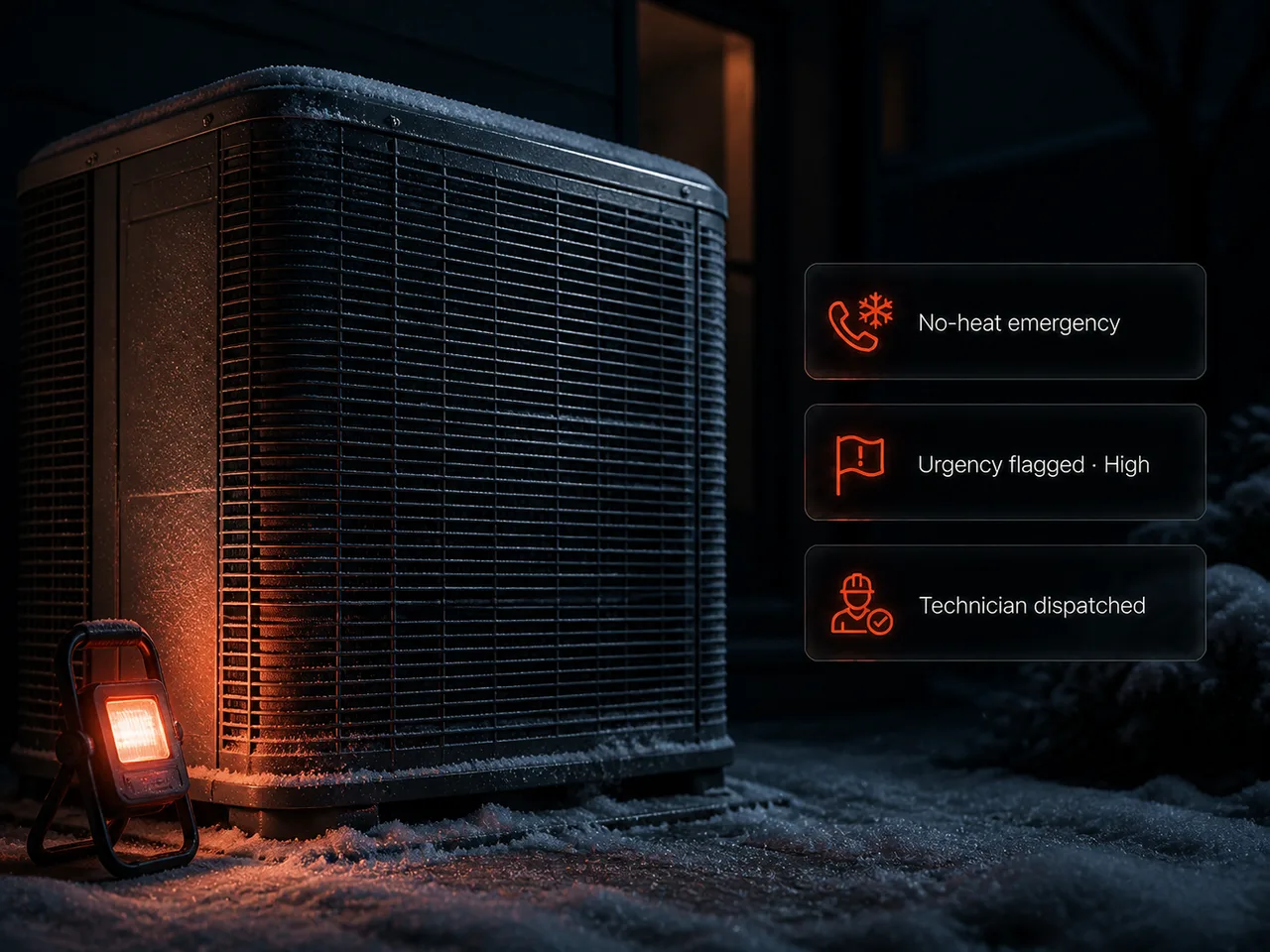
Homeowner with no heat in January. The agent confirms the address is in your area, captures the system type and symptoms, applies your emergency criteria, and pages the on-call tech while telling the customer someone is being reached.
Five callers in three minutes, first day over 95.
Heat wave hits and the line floods. The agent takes the callers in parallel rather than one at a time, books the routine repairs across the week, and flags the two genuine emergencies for same-day dispatch.
“What would a new system cost?”
Price shopper researching a replacement after dinner. The agent explains how your quoting works, captures the home size and current system, and books an in-home estimate before they call the next three contractors.
Annual service plan renewal.
Existing customer calling about their maintenance agreement. The agent confirms the plan, books the seasonal tune-up, and does it without interrupting anyone in the office who is quoting a replacement.
Built so it never books a job you cannot service.
An HVAC AI assistant is only useful if it respects your service area, your pricing, and your capacity. Yours is configured with hard rules.
Your service area, enforced
Out-of-area callers are told politely rather than booked. No tech drives 40 minutes to a job you never wanted.
Your escalation protocol
You define what wakes the on-call tech and what waits until morning. The agent never makes that judgment call on its own.
No invented pricing
It quotes the call-out and diagnostic fees you give it. Full system pricing goes to an in-home estimate, never a guess on the phone.
Your company voice
Greeting, tone and script tuned to your business. Callers hear a competent office, not a menu tree.
Plugs into the tools your shop already runs.
Google Calendar
Two-way sync. Jobs booked on a call land on the schedule in real time with the arrival window.
Zapier
Bridge to thousands of tools, including field service platforms, spreadsheets and email.
HubSpot
Every enquiry flows into your CRM with the address, system details and what they called about.
Slack
Emergency flags and new bookings drop into a channel your dispatcher actually watches.
AI receptionists for HVAC companies, your questions answered.
It is an AI voice agent that answers your company phone around the clock. It qualifies the job, checks the address against your service area, triages emergencies against rules you set, quotes your call-out fee and books into your calendar. Unlike a traditional answering service, it can book rather than just take a message.
A general assistant can hold a conversation but knows nothing about your business. An HVAC voice assistant built for your company is configured with your service area, hours, pricing, on-call rotation and escalation rules, and it is connected to your calendar so it can actually book work. It is a phone system that does a job, not a chatbot with a voice.
It applies the criteria you give it. You decide what counts as an emergency, no heat below a certain temperature, a gas smell, a vulnerable occupant, and the agent follows those rules exactly. It escalates what matches and schedules what does not, so your on-call tech is only woken for the real ones.
It answers several calls at the same time rather than one after another, so a spike does not go to voicemail the way it would with a single person on the phone. Exact concurrency depends on your plan, and we size it to your call volume before you go live. It is a large improvement on one front desk, not an unlimited one.
No, and that is deliberate. It quotes the call-out and diagnostic fees you provide, then books an in-home estimate for anything involving replacement. Guessing at system pricing on the phone loses jobs and creates arguments at the door.
A single-location contractor is typically live in about 7 days. We build the agent around your service area, hours, fees, on-call rotation and escalation rules, then test it with you before it answers a single customer call.
Less than a part-time dispatcher, and it covers the hours a dispatcher never would. See our pricing page for current plans. If you are comparing options, we also wrote a breakdown of the best AI receptionists for HVAC companies.
Also available for
Hear it triage a no-heat call at midnight.
Book a 20-minute call. Live demo on real HVAC scenarios, straight answers on pricing, and exactly what going live would look like for your business.
Book a demo →