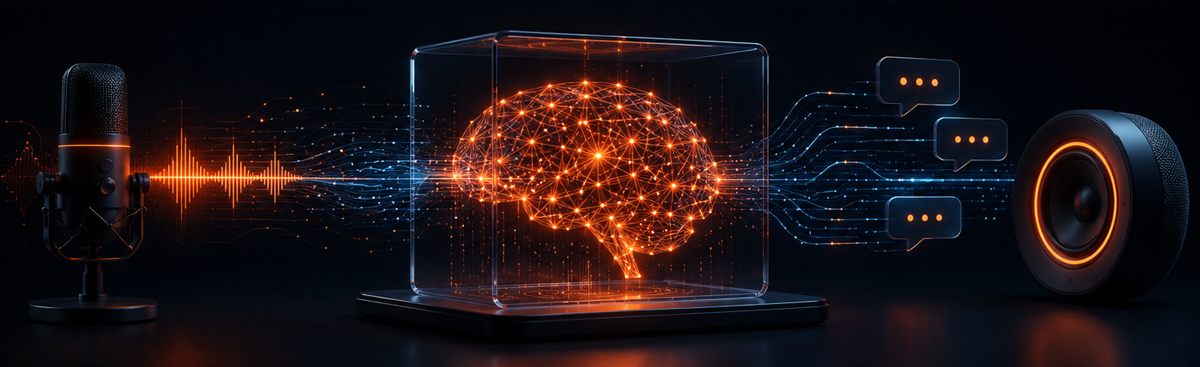
An AI receptionist is software that answers your business phone, holds a natural conversation with the caller, understands what they need, and takes action — booking an appointment, answering a question, or passing the call along. It does this by combining three pieces: speech recognition (to hear the caller), a language model (to understand and decide what to say), and a natural voice (to respond). The whole loop happens in real time, so the caller experiences a normal conversation.
What is an AI receptionist?
An AI receptionist is a software-based phone agent that picks up calls and talks with the caller, just like a human front-desk staffer would. Unlike voicemail, it doesn’t make the caller leave a message. Unlike a phone menu (IVR), it doesn’t make them press buttons. The key point: it converses.
Where voicemail and IVR put work on the caller, an AI receptionist takes work off them — the same way a good human receptionist does.
How it works, step by step

- It hears the caller. Speech-to-text converts spoken words to text in real time.
- It understands. A language model interprets intent (“I want to book a cleaning next week”).
- It decides and acts. Checks the calendar, answers the question, or routes the call.
- It responds. Text-to-speech replies in a natural voice. The loop repeats until the call is done.
- It logs everything. Transcript and details sent to the business.
What can an AI receptionist do?
- Answer calls 24/7, including weekends and holidays
- Book, reschedule, and cancel appointments
- Answer common questions about your business
- Capture caller details and qualify leads
- Route urgent calls to a human
- Handle multiple calls simultaneously
What it can’t (or shouldn’t) do
To be straight: an AI receptionist is not the right tool for every call. Complex emotional conversations, highly unusual requests, or anything needing real human judgment should route to a person. A good setup knows its limits and hands off gracefully — that’s the difference between an AI receptionist that frustrates callers and one they don’t mind talking to.
Is an AI receptionist right for your business?
It tends to fit best when:
- You take a high volume of routine calls (bookings, FAQs, status checks)
- You’re missing calls during busy hours or after-hours
- Each missed call has real revenue attached — appointment-driven service businesses especially
If most of your calls are emotionally complex or highly unusual, a human service is probably a better fit. See the honest comparison →
FAQ
Is an AI receptionist the same as a chatbot?
No. A chatbot handles text on a website. An AI receptionist handles voice on the phone — very different tech and very different caller experience.
Can callers tell it’s AI?
Some can, some can’t — voices have gotten remarkably natural. We’re always upfront if a caller asks directly.
Does it replace my staff?
It handles the phones so your staff can focus on the work in front of them. Most businesses use it to absorb routine and after-hours calls, not to replace people doing higher-judgment work.
How is this different from an answering service?
An answering service uses humans in a call center. An AI receptionist is software. More on the answering-service framing →